What if growing a software startup were an incremental strategy game? Instead of pitching investors or writing a business plan, you begin with the one resource a developer knows best: lines of code.
Play Click Me a Startup 2 on itch.io
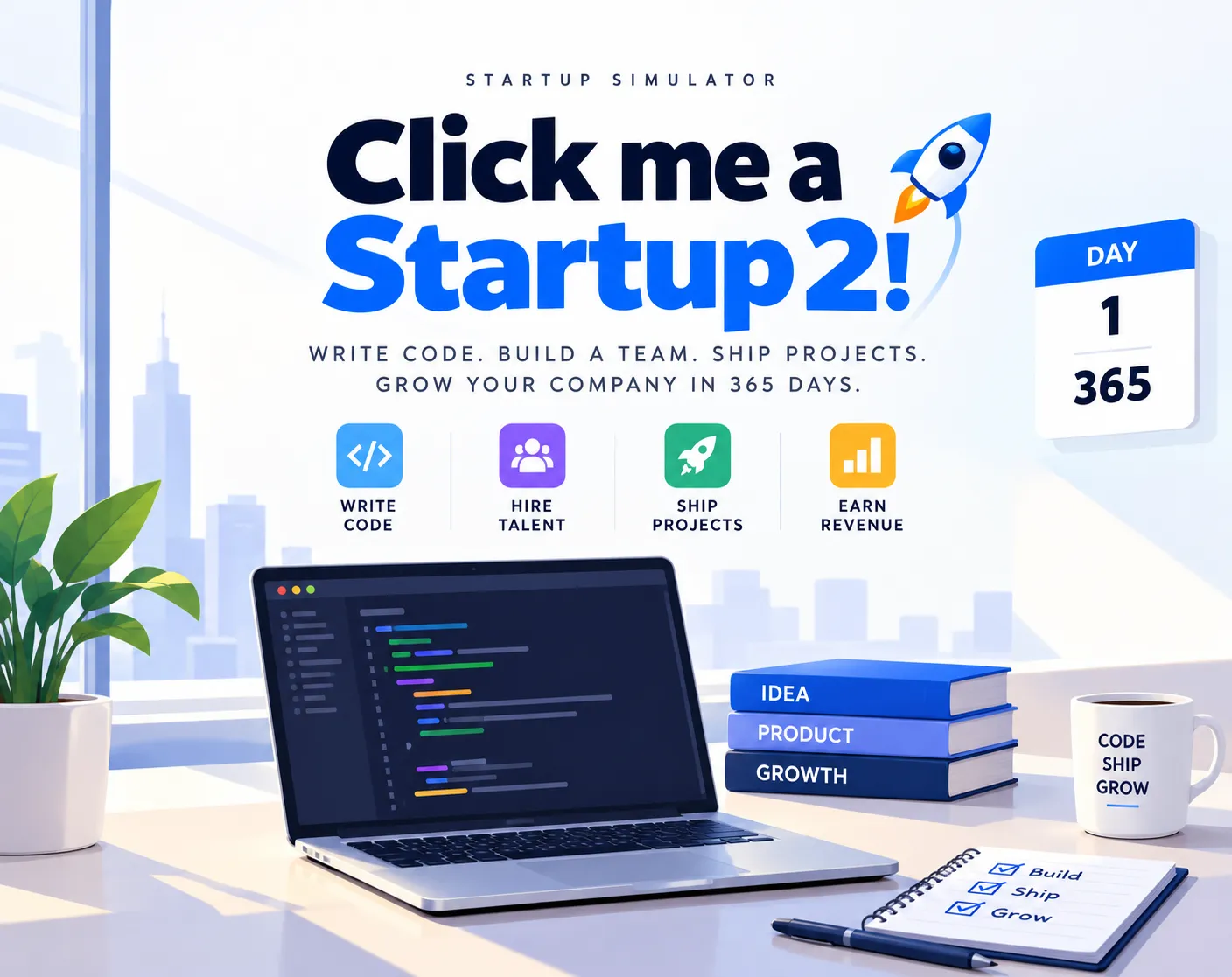
Click Me a Startup 2 is a free-to-play browser-based startup simulator. You start as a solo developer, write code, recruit a team, sell software projects, and balance your company's finances and technical health. The latest public update makes the objective explicit: finish Day 365 with $1,000,000.
Unlike a conventional clicker, the challenge isn't simply generating bigger numbers. Growing too quickly can create expenses, technical debt, and morale problems that threaten the company you're trying to build.
From Game Jam Prototype to a Bigger Startup Simulator
The original Click Me a Startup! began as a small game-jam experiment. Its premise was straightforward: click to produce code, then optimize your way toward a successful software business.
The sequel revisits that idea with more management systems, deeper progression, and a clearer sense of risk and reward. It is still an indie project under active iteration, not an attempt to reproduce every detail of running a real company.
That simplicity is part of the appeal. You don't need to understand accounting or programming to play, but developers will recognize the trade-offs immediately.
The Core Loop: Code, Hire, Ship, Repeat
Your early resource is code. Clicking produces lines, and those lines unlock actions that help you grow beyond a one-person operation.
The broad gameplay loop looks like this:
- Write code: Generate the lines you need to take your first steps.
- Find candidates: Spend resources to access potential hires.
- Build a team: Recruit people with different costs and contributions.
- Ship and sell projects: Convert work into revenue.
- Upgrade operations: Improve output, hiring efficiency, or project income.
- Manage the consequences: Watch expenses, tech debt, quality, and morale while time advances.
The game uses accelerated time: eight hours of real time correspond to one in-game day, according to the creator's description. This makes growth a longer-term balancing exercise rather than a single burst of clicking.
Hiring Isn't Just a Productivity Upgrade
Many incremental games treat new workers as simple multipliers. Here, staffing introduces trade-offs.
Interns are affordable, but relying too heavily on them can increase technical debt. Junior and senior developers contribute different levels of productivity and quality. HR can generate candidates passively, while team leads and product managers support morale and project sales. The game also includes AI agents, which offer substantial output with their own trade-offs.
This turns hiring into a strategic decision. A large workforce may write code faster, but it also increases operating costs. A cheaper team may look attractive until accumulated technical debt starts hurting performance.
The lesson is familiar to anyone who has worked on a real software product: headcount and output are not the same thing as sustainable progress.
Projects Turn Code Into Revenue
Code by itself doesn't pay the bills. Selling projects is how your startup earns money.
Project opportunities unlock through technology-themed tiers, beginning with familiar web-development foundations such as HTML, CSS, JavaScript, and TypeScript. This progression gives developers an amusing way to recognize their own career journeys inside the game.
In the October 30 update, the creator added a Sell Project button directly to the main Work screen. Selling from there costs 10 lines of code, reducing the need to navigate between tabs for a routine action. Early HTML project rewards were also increased to $24, making initial revenue easier to reach.
Those adjustments matter because early-game pacing can determine whether a management sim feels rewarding or frustrating.
The Real Enemies: Burn Rate and Technical Debt
As soon as you start hiring, running the company costs money. The game models recurring expenses with items such as Wi-Fi, coffee, and pizza, scaling them with the number of people on the team.
A recent update clarifies that expenses remain at $0 before your first hire and that recurring expenses are charged every seven in-game days. That gives solo players a chance to establish their first revenue stream before payroll-related pressures arrive.
Meanwhile, technical debt, morale, code quality, prestige, mentorship, and stability create additional constraints. Maximizing one number while ignoring the others can leave the startup vulnerable.
For example, hiring many low-cost workers may accelerate production but create debt that becomes difficult to manage. A smaller, better-balanced team may grow more slowly but stay healthier.
A Clear Win Condition: Day 365 and $1 Million
The updated version prominently states the target: reach $1,000,000 by Day 365.
That gives each decision a purpose. Should you spend scarce resources on another employee, an upgrade, or a project that produces immediate cash? Should you chase fast growth or invest in keeping the company stable?
It's a simplified simulation, of course. Real startups aren't measured by a single cash target. But a concrete finish line makes the game's interconnected systems easier to understand and gives players a reason to experiment with different strategies.
Recent Improvements Driven by Player Feedback
The October 30, 2026 development update describes several changes aimed at making the first playthrough clearer:
- A visible $1 million / Day 365 goal, with an option to hide its banner.
- No recurring expenses until the first hire.
- A Sell Project action on the Work screen.
- Higher early HTML project rewards.
- Charts tracking code production and money over time.
- A clearer seven-day expense display.
- A quick restart option from the main menu.
These are not flashy features, but they address common usability problems in simulation games: unclear objectives, hidden costs, and too much friction between decisions.
Built With React and Vite
The creator built the game with React and Vite, demonstrating that modern frontend tools can power more than dashboards and websites.
The interface also includes developer-friendly themes such as Light, Monokai, Dracula, and Solarized Dark. It's a small touch that fits a game built around writing code.
For aspiring indie developers, this project is an interesting example of how an approachable concept can grow through iterative releases. Start with a functioning loop, observe where players struggle, then improve balancing and clarity before adding more complexity.
Who Should Play It?
Click Me a Startup 2 is worth a look if you enjoy:
- Incremental and idle games: Watching modest actions develop into bigger systems.
- Management simulations: Making trade-offs between growth, expenses, and operational health.
- Software development culture: Recognizing familiar roles, technology tiers, and technical-debt problems.
- Short indie experiments: Trying a free browser game without a complicated installation process.
It's particularly appealing to developers who have ever wondered whether they could run a software company more effectively than the management teams they've worked with.
What Could Come Next?
The creator has said that more mechanics and balancing updates are planned, but has not committed to a specific feature roadmap in the referenced announcement.
Potential directions—not announced features—could include building recurring-revenue SaaS products, handling customer churn, negotiating contracts, or choosing between bootstrapping and outside investment. Such systems would deepen the central question: how do you build a company that can survive its own growth?
Final Thoughts
Click Me a Startup 2 takes the familiar mechanics of a clicker game and gives them a software-business twist. Its most interesting idea is that faster output doesn't automatically mean a healthier company.
You can produce more code, hire more people, and sell more projects, but each advantage introduces another decision. That's where the strategy emerges.
The game is free to play in a browser, and its creator is actively responding to player feedback. Whether you're an incremental-game fan or a developer looking for a playful take on startup management, it's an accessible experiment worth trying.
Play Click Me a Startup 2 on itch.io
TL;DR
- Click Me a Startup 2 is a free browser-based incremental startup simulator.
- Start as a solo developer and grow by writing code, hiring employees, and selling projects.
- Manage recurring expenses, technical debt, morale, and code quality.
- The current goal is to finish Day 365 with $1,000,000.
- Built with React and Vite, the game has received early balancing and usability improvements.
- It is available on itch.io and continues to evolve through feedback.
Sources and Further Reading
Sat Oct 31 2026