In an industry where games compete through photorealistic graphics, enormous open worlds, and increasingly expensive production, some of the most interesting experiences come from individual creators with a distinctive vision.
Allogloom is one such game.
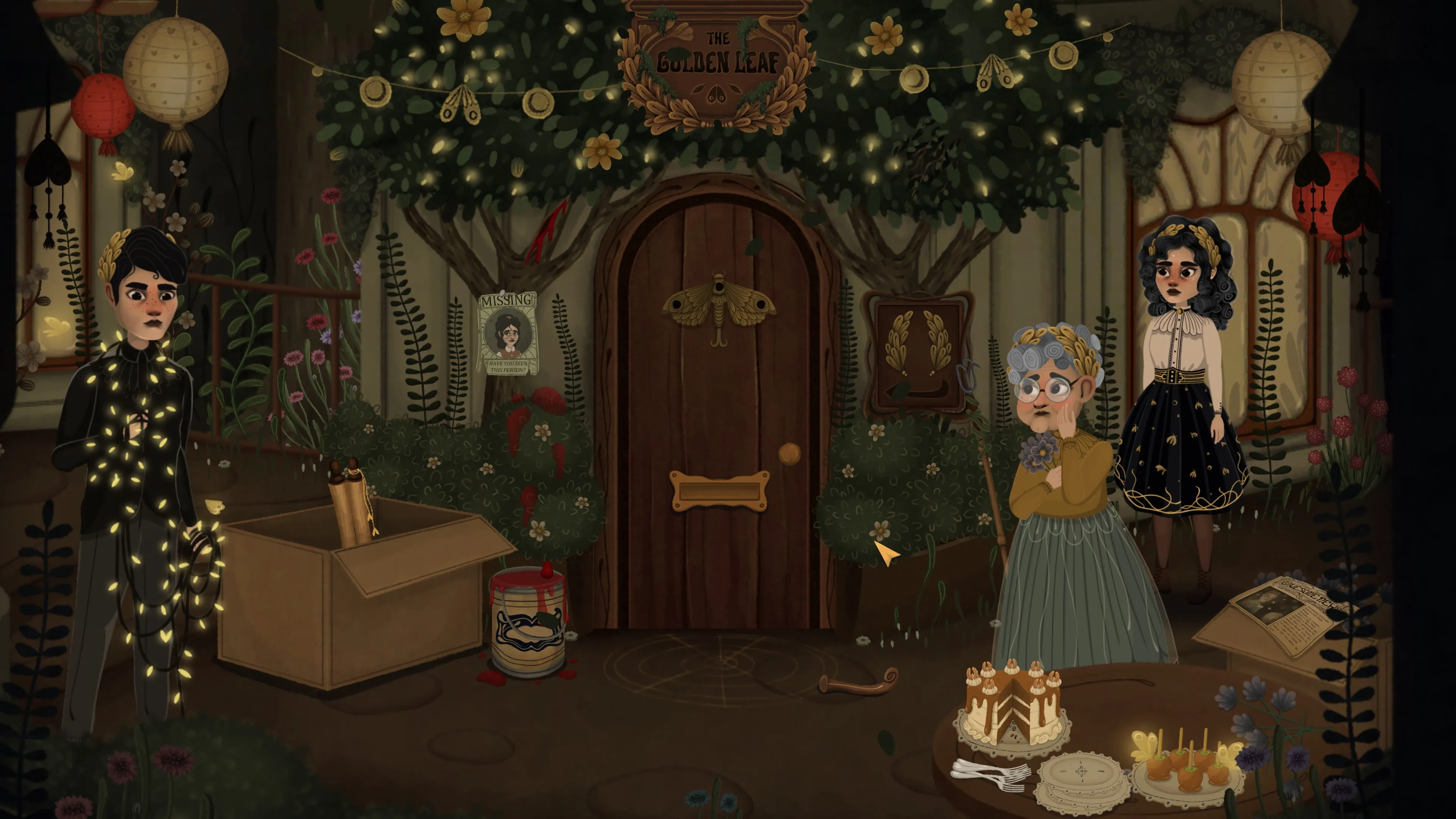
Created by New Zealand solo developer Kate, also known as Galactic Ghosty, Allogloom is a hand-painted point-and-click adventure that combines dark fairy-tale aesthetics, peculiar characters, and a mystery rooted in the history of its world.
Released on October 13, 2026, and published by Iceberg Interactive, the game takes players into Gruesome Grove, a town where residents have begun disappearing and long-buried secrets threaten those who remain.
What makes Allogloom interesting is not simply its artwork or its unusual setting. It is the relationship between its puzzles and its storytelling.
Rather than treating puzzles as obstacles placed between story sequences, Allogloom is designed around the idea that solving problems should feel like a natural part of discovering the narrative.
A Dark Fairy Tale That Looks Like an Illustrated Storybook
Allogloom's visual identity immediately separates it from many contemporary indie games.
Its backgrounds, characters, and creatures are hand-painted, with strong influences from Art Nouveau illustration and architecture. The resulting world resembles a beautifully illustrated storybook that gradually reveals something unsettling beneath its charming surface.
The visual contrast is deliberate. Friendly-looking creatures inhabit strange environments, while playful details coexist with darker implications.
In a June 2026 interview with ScreenHub, Kate explained that she wanted to combine her love of illustrated storybooks with creepy imagery.
This approach gives Allogloom a distinct identity without depending on graphical realism.
For independent developers, there is an important lesson here: visual consistency can be more memorable than technical complexity.
A game does not need the most advanced rendering engine to establish atmosphere. It needs an artistic language that supports the experience it wants players to have.
The Mystery of Gruesome Grove
The story follows Nora, who discovers that people in her hometown are disappearing.
With a mysterious note pointing toward somewhere forbidden, Nora begins investigating the disappearances. Her journey takes her through unfamiliar places, introduces her to strange creatures, and forces her to confront truths that some residents would rather leave buried.
The adventure spans eight chapters and six worlds, according to the game's launch announcement.
The setting also features unusual customs and inhabitants, including revered but ravenous moths and monsters displaced from their homes.
These details help establish a world with its own history, rules, and contradictions.
Importantly, Nora is not simply exploring a collection of unrelated puzzle rooms. She is trying to understand what happened to her town and how its past connects to the present crisis.
That distinction shapes the game's approach to interaction.
When Puzzles Become Part of the Narrative
Traditional point-and-click adventures often rely on collecting objects, combining items, and using them to overcome obstacles.
Allogloom includes these familiar mechanics, along with conversations and negotiations with characters. However, its defining design ambition is to make those interactions meaningful within the story.
In her ScreenHub interview, Kate explained that she designed the puzzles around the narrative, rather than constructing a story merely to connect puzzle sequences.
This is a subtle but significant design decision.
Consider two hypothetical approaches to a locked door.
In a conventional puzzle, the player might search several rooms, find a key, and unlock the door. The puzzle functions primarily as a barrier to progress.
In a narrative-driven puzzle, the player might need to understand why the door was sealed, discover the customs surrounding it, or persuade someone with knowledge of its history to help.
Both approaches involve problem-solving, but the second makes understanding the world part of the solution.
This example illustrates the design principle rather than describing a specific puzzle from Allogloom.
The strongest narrative puzzles reward players for paying attention to the setting, its characters, and the information they encounter.
Environmental Storytelling Through Interaction
Environmental storytelling is often associated with abandoned buildings, scattered notes, mysterious objects, and visual clues.
Games such as Hollow Knight, Outer Wilds, and Return of the Obra Dinn demonstrate different ways that players can reconstruct stories through exploration and observation.
Allogloom approaches a related design challenge through its point-and-click structure.
The player is encouraged to examine environments, interact with unusual objects, and speak with characters whose knowledge may be necessary to move forward.
The important relationship is between observation and action.
A detail in the environment can serve several purposes simultaneously. It might establish atmosphere, reveal something about a character, or provide information relevant to a later puzzle.
When these functions overlap, exploration becomes more rewarding.
Players are not merely searching for interactive objects. They are developing an understanding of the world.
That understanding can become a gameplay resource in its own right.
Why Puzzle Difficulty Is a Storytelling Problem
There is a delicate balance in designing narrative puzzles.
If the solutions are too obvious, the player may feel that the game offers little challenge. If they are too obscure, the story can lose momentum while the player repeatedly experiments with unrelated items.
Kate has discussed this challenge openly.
During development, she used extensive playtesting to understand how different players approached the same puzzles. Some players immediately recognized a solution, while others struggled with identical information.
Her goal was to create challenges that players could solve using clues available within the game, without needing to search online for walkthroughs.
This matters because frustration changes the emotional experience of a story.
A mystery should encourage curiosity. It should not make players feel that they are fighting the game's interface or guessing the developer's intentions.
Good puzzle design establishes a logical relationship between available information and the required solution.
For narrative adventures, clarity is not necessarily the enemy of difficulty. A puzzle can be challenging while still feeling fair.
The Advantage of a Solo Developer's Vision
Allogloom is particularly interesting because its creative direction comes largely from one person.
Kate taught herself multiple disciplines while developing the game, including illustration, game design, writing, and animation.
Her development journey began with an interest in modifying games and creating small pieces of custom artwork. Over time, that curiosity developed into the ambition to build a complete adventure.
Solo development creates obvious limitations.
A single creator cannot match the production capacity of a large studio. Every new feature, animation, background, or puzzle requires time that could otherwise be spent improving another part of the game.
However, solo development can also provide a strong sense of creative consistency.
When the same person designs the world, writes its characters, and develops its puzzles, there is an opportunity to connect those elements more closely.
That does not automatically make a game better. Solo developers still need feedback, testing, and outside perspectives.
In Allogloom's case, Kate received support from collaborators, including composer Kim Miller, while Iceberg Interactive helped with publishing, marketing, and testing.
The project demonstrates how an individual creative vision can be supported without losing its distinctive identity.
Art Direction Is More Than Decoration
One of the most useful lessons from Allogloom is that visual design can influence how players interpret a game.
Its Art Nouveau-inspired illustrations are not merely decorative assets. They establish the tone of Gruesome Grove and make its unusual inhabitants feel like parts of the same fictional universe.
This is especially important in a game that moves between charming humor and unsettling mystery.
A visually inconsistent world can make those tonal shifts feel accidental.
A cohesive art style, however, allows contrasting emotions to coexist.
Players can encounter something adorable and unsettling within the same scene because both belong to the same artistic language.
For indie developers working with limited budgets, this offers a practical alternative to pursuing graphical fidelity.
Rather than asking how to make a game look more realistic, creators can ask what visual identity best communicates the game's personality.
The Return of the Point-and-Click Adventure
Point-and-click adventures have a long history, from the classic LucasArts era to modern independent games.
The genre has traditionally emphasized exploration, dialogue, inventory management, and logical problem-solving rather than reflex-based action.
Its relatively approachable control scheme also creates room for experimentation with storytelling.
Allogloom builds on that tradition while adopting a highly distinctive visual identity.
It combines familiar mechanics with a dark fairy-tale setting and a narrative that unfolds through interaction.
The game also shows why point-and-click adventures remain attractive to smaller development teams.
They can concentrate their production effort on carefully designed environments, characters, dialogue, and puzzles instead of requiring large-scale combat systems or expansive simulations.
That does not make them easy to create.
Strong puzzle design requires careful planning, iteration, and testing. A beautiful environment is only one part of a satisfying adventure.
Nevertheless, the genre offers opportunities for creators whose strengths lie in writing, illustration, and world-building.
What Indie Developers Can Learn From Allogloom
There are several useful design principles illustrated by Allogloom's development.
1. Start With a Clear Creative Identity
A distinctive artistic direction can make a small game recognizable even in a crowded marketplace.
2. Connect Mechanics With the Story
Puzzles should feel like natural consequences of the world and its characters rather than arbitrary obstacles.
3. Design for Player Understanding
A satisfying puzzle gives players enough information to reason toward a solution without removing the challenge.
4. Use Playtesting to Identify Confusion
What appears obvious to a developer may be unclear to someone experiencing the game for the first time.
5. Prioritize Cohesion Over Scale
A smaller, carefully constructed world can offer a stronger experience than a larger collection of disconnected features.
6. Accept Collaboration Without Losing Direction
Solo development does not require rejecting assistance. Music, publishing, testing, and feedback can strengthen an independently led project.
Is Allogloom Worth Exploring?
Allogloom is likely to appeal to players who enjoy atmospheric adventures, unusual characters, dark humor, and puzzles that reward curiosity.
Its hand-painted presentation offers a strong visual identity, while the narrative-driven design aims to make exploration and problem-solving feel connected.
Players looking primarily for action-heavy gameplay may find its traditional point-and-click structure less appealing.
For fans of mystery adventures and illustrated fantasy worlds, however, Allogloom offers an interesting example of what a focused independent project can accomplish.
The game launched for PC on October 13, 2026, with Iceberg Interactive as publisher.
Its official Steam listing provides the latest information on availability, supported languages, and system requirements.
Final Thoughts
Allogloom highlights an important principle in game development: meaningful experiences do not necessarily require enormous production budgets.
A strong artistic identity, thoughtful puzzle design, and a coherent fictional world can create something memorable.
What makes the project particularly interesting is the way its creative disciplines intersect.
The illustrations establish the atmosphere. The characters give the world personality. The puzzles encourage players to understand its rules. The narrative provides a reason to keep exploring.
Together, these elements demonstrate the potential of storytelling through systems rather than storytelling that simply interrupts gameplay.
For independent developers, Allogloom is a reminder that originality often comes from the relationships between familiar ideas, not necessarily from inventing entirely new mechanics.
TL;DR
- Allogloom is a hand-painted point-and-click adventure developed by New Zealand solo creator Kate, also known as Galactic Ghosty.
- The game was released on October 13, 2026, and published by Iceberg Interactive.
- Players follow Nora through Gruesome Grove while investigating mysterious disappearances and uncovering hidden history.
- Its eight-chapter adventure spans six worlds and combines item puzzles, character interactions, and dark fairy-tale storytelling.
- The game's puzzle design emphasizes narrative context and information available within the world.
- Extensive playtesting helped refine the balance between difficulty and accessibility.
- Allogloom demonstrates how distinctive art direction and cohesive storytelling can help solo-developed games stand out.
References
- Official website: https://www.allogloom.com/
- Steam: https://store.steampowered.com/app/2644100/Allogloom/
- Developer interview: https://www.screenhub.com.au/news/interviews/allogloom-game-developer-interview-2702115/
- Launch announcement: https://press.piratepr.com/a-grim-little-fairytale-allogloom-is-out-now
Wed Oct 21 2026